Tuesday, 11 June 2013

Recent parliamentary question on teens and abortion

Below is a recent question asked in parliament, about teenage girls and abortion. The answer and tables are presented below. In 2010 3,716 teenage girls between 13-15 years old in England and Wales had an abortion. Two girls under 13 had and abortion. Also in 2010, 22,870 teenagers aged 16-18 had an abortion. David Paton, professor of economics at the university of Nottingham, is one of the foremost experts in the UK on teen pregnancy, contraceptive provision, and abortion, especially under the previous government and has written valuable studies on this topic. You can read his studies and presentations on the internet and on the SPUC director blog.

Every year SPUC sends trained speakers into secondary schools, colleges, and universities all over the UK, presenting an accurate fact-based pro-life presentation for students. It is one of the most important things we do, because pupils and students deserve to hear the truth. To find out more email email eileenbrydon@spuc.org.uk or danielblackman@spuc.org.uk 

Abortion: Young People

Mr Andrew Turner: To ask the Secretary of State for Health how many and what proportion of abortions were performed on (a) children under 13 years old, (b) 13 to 15 years olds and (c) 16 to 18 year olds in the smallest geographical NHS area for which information is available in (i) 2012, (ii) 2010 and (iii) 2008.

Anna Soubry: Data are set out in the following tables. Data for 2012 are not yet available; data for 2011 (the most recent published) have been shown instead.

Abortions: totals, rates and percentages, by age groups under 19 and strategic health authority 2008
Total abortionsPercentages of total
Under 1313 to 1516 to 18Total allUnder 1313 to 1516 to 18All ages
England and Wales74,10626,541195,2960214100
England73,87725,115186,2180213100
North East12401,2407,4820317100
North West06083,87525,0190215100
Yorkshire and the Humber14782,58316,6990315100
East Midlands13141,90612,4090315100
West Midlands04643,03720,4760215100
East of England13122,28816,4600214100
London36034,58748,679019100
South East Coast02811,89913,2480214100
South Central02501,53711,9340213100
South West03272,16313,8120216100
Wales02291,4269,0780316100
Abortions: totals, rates and percentages, by age groups under 19 and strategic health authority 2010
Total abortionsPercentages of total
Under 1313 to 1516 to 18Total allUnder 1313 to 1516 to 18All ages
England and Wales23,71622,870189,5740212100
England23,49921,664180,9420212100
North East12171,0167,0290314100
North West05533,39524,9330214100
Yorkshire and the Humber14072,13015,5470314100
East Midlands02911,55111,8690213100
West Midlands04552,57620,3310213100
East of England03132,15516,8290213100
London05023,91146,686018100
South East Coast02551,78313,2000214100
South Central01941,30111,5330211100
South West03121,84612,9850214100
Wales02171,2068,6320314100

Thursday, 6 June 2013

Graduating this summer?

Every year students graduate from university, which is great, but it means it's easy to find oneself like a fish out of water when it comes to carrying on the pro-life work.

For several years the university  has been a place where you get to meet and spend time with like-minded peers. You get to attend talks, have discussions, plan events, go to conferences together, share news, and stay connected using the useful Facebook groups and pages.

Graduating will mean leaving than context behind. It'll mean moving back home, or moving into new rented accommodation, perhaps in a new city. The job-hunt will be well underway, or perhaps you'll be starting a new job.

These things quickly and easily take up lots of time and energy. That, minus the pro-life peer group, and it's easy for pro-life activity to slide to the bottom of the list. It might feel like there is nothing going on where you live, certainly nothing where you work, nor at your local church if you attend one.

So, it's important that you, we, don't let that happen. There's a lot to be said about keeping good friendships going anyway, but how much more when you share a common purpose. Below are some suggestions that can help with the transition from university.

 1. Don't drift from pro-life peers. There's a million ways to stay in touch, so no excuses.

2. Stay informed - carry on reading the news sites, blogs, postings on Facebook groups, sign up for updates from pro-life groups, follow pro-life groups on Twitter and Facebook, read articles and books.

3. Order a batch of leaflets and do door-to-door leafleting where you live. Do a few streets and keep a note of the ones you've done. Email danielblackman@spuc.org.uk to make an order.

4. Join a local SPUC branch (email tonymullet@spuc.org.uk for your nearest branch). The branches effectively operate as a pro-life presence in a given area: letter-writing, fundraising, distributing petitions and newspapers, getting church members active, leafleting, pro-life chains, display tables and so on. If there is no SPUC branch where you live, start one. It's not difficult.

6.  Go along to your local 40 Days for Life vigil. Again, if there isn't one, start one in your area. However, starting one and keeping it going for 40 days, requires lots of time, so only take such a role on if you're certain you can commit to it properly.Good Counsel Network also run daily vigils in London.

7. Letter-writing to your local MP, local newspapers, and religious leaders. Share information with them, raise a point about something that is happening in parliament. It's easy for an MP or church leader to think no one cares about pro-life issues because no one ever writes or speaks to them about it.

8. Volunteering is another good practical thing to do. There are pro-life pregnancy centres and SPUC offices that have plenty for volunteers to do. Email danielblackman@spuc.org.ukif you'd like to volunteer. 


Tuesday, 4 June 2013

A baby is born, thanks to a young woman who talks the talk and more importantly, walks the walk

I received this email (below) from a friend, Kelechi. She has been a regular volunteer with SPUC in our London office, has attended several of our conferences and training days, including the conference on international development, maternal health, and abortion.

Through SPUC, Kelechi came into contact with 40 Days for Life (we went to the fundraising banquet in Westminster a few years ago). We also provided Kelechi with advice and some materials (foetal model set, leaflets etc). Since then Kelechi has been a regular member of the 40 Days for Life in Milton Keynes (an initiative that involves a public prayer vigil outside an abortion facility, prayer and fasting, and community outreach). She also went over to her home town of Abuja, Nigeria, in January. She spoke at several churches and halls, leading to the founding of the pro-life group "Save the Unborn Babies" Nigeria. She also helped to establish a 40 Days for Life campaign in Nigeria. As a result at least 6 babies have been spared abortion. In fact, Kelechi has made and will continue to make trips back to Nigeria to ensure Save Unborn Babies develops and keeps up its lifesaving and educational work. On top of all this Kelechi works full-time as a business studies lecturer at a college of further education.

In my opinion, Kelechi is a excellent example of a motivated young woman who has put her pro-life conviction into effective action - outward facing, bringing the message to wider society, not being stuck in a cycle of jumping from talk to talk, conference to conference - talking the talk but doing little else. We are honoured to be able to work with her.
Dear SPUC Family,

Please rejoice with us at Save The Unborn Babies Pro-Life Initiative Nigeria, as our first saved baby was delivered on Friday, 31st May at about 1:25 am. Mum and baby are doing very well, and we are pleased to affirm that it is through your kind support that this baby boy has been saved from the abortion her mother had intended for him.

This baby may not have been here today if you did not give me the opportunity to work with SPUC as a volunteer while receiving pro-life training, nor join 40 Days for Life at Milton Keynes and other pro-life activities in Luton Good Counsel. Thank you also for your kind support with educational materials and encouragement towards my visit to Nigeria for pro-life work.

In December when I visited Nigeria, this new mum (then pregnant) had made some money deposit for an abortion and was in search of the balance to undergo the procedure. After I spoke in Church, she met me crying as she unfolded her ordeal, telling how her fiance kicked her out of the house despite her pregnancy. We encouraged her to keep her baby while supporting with her ante-natal bills. A member also offered her an accommodation. On Friday, 30th May, the young lady called me with the good news that she has put to bed. All glory be to God.

I must thank you all at SPUC for your encouragement and support to embark on this mission which has helped save this baby boy from forced death. Many thanks to Andy Burton's 40 Days for Life, Milton Keynes and Luton Good Counsel for their inspiration. It is incident like this, that give us fulfilment and encouragement to keep on doing the work.
God bless you all.
Kind regards,
For: Save The Unborn Babies Pro-life, Nigeria
Kelechi Anyaghara

First baby born, and sleeping well by the looks of it
Kelechi (3rd from left) at the SPUC maternal health conference with speakers and SPUC staff
Kelechi with 40 Days for Life founders at the London banquet
Young adults hold a public pro-life display
Kelechi speaking to a local group, telling them about pro-life work
Kelechi gave a training session to a group of recent graduates

Wednesday, 29 May 2013

Missionaries to society

On the 25 May 2012 The Daily Telegraph reported that the Home Secretary Teresa May said "homosexuals will be missionaries to the wider society and make it stronger." She made this comment in relation to government plans to legalise same-sex marriage. 

In the same vein pro-abortion voices say they defend abortion because they take motherhood so seriously. Similarly, self-described pro-choice advocates present abortion as a means of exercising free choice and ensuring women's equality. 

What we have is a moral inversion - bad is called good. That which causes harm is called enhancing. 

What our society continually and urgently needs is for pro-lifers, those who believe in the dignity of the human person from conception, and the institution of heterosexual marriage as best for children born and unborn, to be missionaries to the wider society, and make it stronger. We can and should go to talks and conferences, read articles, and learn the arguments, but if we do not take the message to others we are not being effective. We end up creating a pro-life cottage industry where we talk to ourselves about what we already know and agree upon.

Pope Francis, in 2005 whilst still a cardinal in Argentina, gave a sermon to a group of pro-lifers. His sermon included the following message. Although it will have obvious relevance for Christians, especially Catholics, it's useful for us all in appreciating the spirit we need in order to be missionaries to the wider society:
But it is a road that is full of wolves, and perhaps for that reason they might bring us to the courts, perhaps, for that reason, for caring for life they might kill us.  We should think about the Christian martyrs.  They killed them for preaching this Gospel of life, this Gospel that Jesus brought.  But Jesus gives us the strength.  Go forth!  Don't be fools, remember, a Christian doesn't have the luxury of being foolish, I'm not going to repeat, an idiot, a fool, he can't give himself the luxury.  He has to be clever, he has to be astute, to carry this out.
Society, unborn children and their parents, need you to be a missionary right where you live - whether village, town or city. Taking the pro-life message to the public - leafleting, table displays, prayer vigils, pro-life chains, walks of witness, supporting pro-life pregnancy centres, writing letters to local and national press, calling into radio shows, objecting to BPAS and Marie Stopes abortion adverts in pub and club toilets etc etc - not only brings the message to a wider audience, but also strengthens our resolve to be actively pro-life.

Fr (Blessed) Miguel Pro, Mexican martyr 1927
White Rose movement - student resistance to Nazi atrocities
Greensboro Woolworth restaurant sit-ins 1960


Pakistani politician Shahbaz Bhatti murdered for opposing oppressive sharia laws
Pro-life street display table
Large pro-life prayer vigil
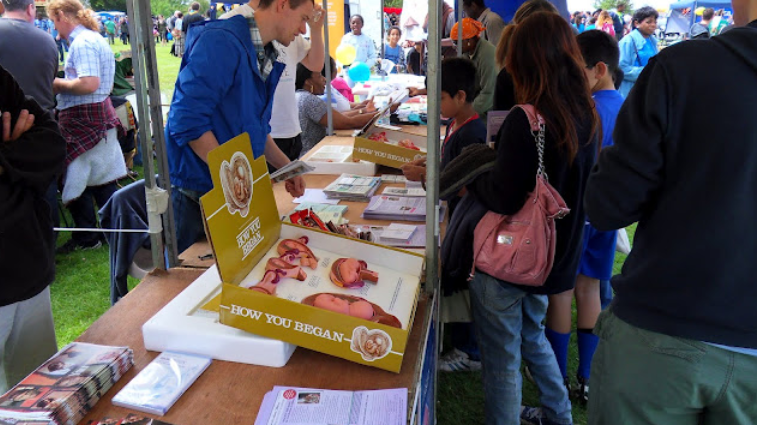
Pro-life display table at a local council festival


SPUC's Anthony Ozimic explaining the nature of marriage on national television

 Young adults March for marriage in Paris
Pro-life tour with the Olympic torch
Post-abortive mothers public witness
Email your name, address, and number of pro-life leaflets you want: danielblackman@spuc.org.uk

Tuesday, 28 May 2013

Hitler's Struggle for Eugenics: Part I

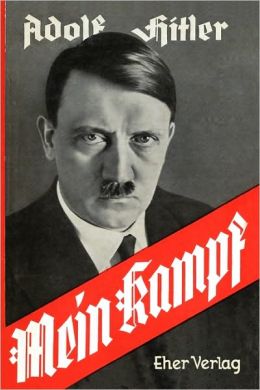
Hitler’s Mein Kampf is one of the most notorious works of the twentieth century. It is generally recognised as being the blueprint for the atrocities committed by the Nazi regime between 1933 and 1945. It is however rarely seen in its correct context as a piece of eugenic literature in the same tradition as Marie Stopes’ Radiant Motherhood, H.G Wells’ A Modern Utopia and Margaret Sanger’s The Pivot of Civilisation. In this series of posts I wish to focus attention on the eugenic principles which not only inform the whole work but which are in fact its ultimate foundation.

The inspiration behind Mein Kampf was Darwin’s theory of evolution by natural selection. Hitler saw races and nations as governed by the law of ‘the survival of the fittest’. Weak races deserved to be outcompeted and subjected to the will of stronger races. This sense of perpetual competition surely informs the title of the book, ‘Mein Kampf’, which means ‘My Struggle.’ Hitler begins his account by outlining how his own life began as a struggle against the overbearing will of his father. Hitler’s attempt to pursue a career as an artist ended in failure and with Hitler eking out a living, homeless, on the streets of Vienna. He was saved from being a victim of natural selection himself by the outbreak of the First World War which provided him with a cause to fight for. The defeat of Germany in November 1918 was a shattering emotional blow and Hitler, like many of his contempories, found solace in the view that Germany had not really been defeated on the battlefield but had rather been betrayed by politicians at home. In the immediate aftermath of defeat Germany was racked by revolution and counter-revolution as Communist uprisings took place across the nation. Hitler was present in Munich during the Bolshevik revolution of 1919 and for him it was a moment of political awakening. He became involved in an extreme fringe of German political life which merged a desire for radical social change with extreme nationalism, often with overt assertions of racial superiority. Anti-Jewish feeling was common among such groups because of the prominent Jewish involvement in the left-wing revolutionary movement as well as older associations of Jews with wealth and capital. The National Socialist ideology, which combined hostility to Communists and Jews with the Darwinian theory of evolution, was appealing to many because it provided a supposedly scientific justification for strong actions to restore German power and punish internal and external enemies.

Hitler’s belief in German superiority had its origins in his Austrian childhood which was marked by assertions by German Austrians of their identity in the multi-ethnic Austro-Hungarian Empire. He had however at one time considered himself hostile to anti-Semitism and in one remarkable passage he describes his earlier disgust at anti-Jewish rhetoric and his horror at the possibility of violence against the Jews. In Mein Kampf  he explains that his views changed after discovering the prominent role of Jews in the Social Democratic movement, which he detested, and their role in socialist and Marxist movements in general as well as in immoral industries such as prostitution. These feelings hardened during the post-war revolutionary period because many of the revolutionary leaders were Jewish. These reasons however are not sufficient to account for the full horror of the persecution and genocide unleashed under the Third Reich. The Nazi regime did not seek out Jews who were political opponents but rather all people of Jewish ancestry whatever their religious beliefs, political views, or social status. This was the result of Hitler’s conviction that the Jewish people were racially different, sub-human, and along with other groups such as Roma and Sinti gypsies in need of extermination. Hitler was not the creator of this ideology; he was simply a student of the international eugenics movement. 

To be continued...

Learn more about the founders of 'scientific racism':


Help fight eugenics today:


Wednesday, 22 May 2013

Baby on board

If you live in London, or just read the news now and again, you would have heard about the Transport for London "baby on Board" badges that pregnant mums are wearing on the lapels of their coats. Here's a few pictures and how to get one for yourself or a friend.


Thursday, 16 May 2013

27,500 chances to help unborn children

In September 2011 SPUC had 400,000 "Abortion: your right to know" leaflets printed. 

SPUC now has 27,500 of these leaflets left.

That's 27,500 chances for you to help unborn children.

2015 will mark the 50th anniversary of the passing of the Abortion Act. If the current abortion rate continues, 9 million unborn children will have been aborted. SPUC is working towards the complete rejection of abortion by society. One of the ways we will do this is by taking the pro-life message to the people via leafleting. You can see the leaflet below.

Last year there was a total of 208,553 unborn children aborted in Great Britain which is more than:
  • the entire university student population of Wales (131, 185)
  • the entire student populations of Oxford, Cambridge, Durham, Imperial College London, University College London, Warwick, Bristol, King's College London, Exeter, London School of Economics, and Royal Veterinary College combined. (statistics taken from the Higher Education Statistics Authority)
If that bothers you, then please order a batch of leaflets and distribute them in your area. 

Email your name, postal address, and number of leaflets to danielblackman@spuc.org.uk 
 
Related Posts Plugin for WordPress, Blogger...