Wednesday, 24 October 2012

Oxford - SPUC Pro-Life universities tour

SPUC is over half way through its universities tour 2012. Last week SPUC travelled up and down the country speaking to student societies at universities. We invited Joseph Meaney, director of international coordination with Human Life International, to speak about "the global pro-life battle and what you can do".

Our first stop-off was the University of Oxford pro-life society, recently started by a group of students headed by Amy Owens.

After a brief tour of Oxford which turned into an unexpected detour, we finally arrived at the venue and were welcomed by the students with tea. 

Joseph talked about the history of abortion and the motivations behind the practise of abortion throughout history. Joseph drew attention to Soviet Russian and 1930s Germany. Then we moved onto the debate about women's rights, radical pro-abortion feminism, and abortion, and concluded with examples and ideas for students to put the pro-life message into action. Starting a pro-life society at university is often not an easy thing to do (Oxford students have already faced opposition). Hosting educational talks, pro-life film screenings, street stalls, and leafleting are practical things that students can do at university and in the towns and cities where they live. 

It is always a pleasure to meet the growing number of pro-life students, and SPUC will continue to support Oxford pro-life students in the coming academic year. There were several good questions afterwards and the discussion continued long after the talk was finished. It's fair to say that Oxford is a place where you want to students to be pro-life and bring that message to other students - we know that so many of our parliamentarians and members of the legal profession and media have studied at Oxford.

Oxford itself is home to Dr. Julian Savulescu, the now notorious academic and editor of the Journal of Medical Ethics, who allowed the paper "After birth abortion: why should the baby live" and then went on to defend his decision to allow its publication and even tried to give it some respectability by citing "eminent" academics like Peter Singer, John Harris, and Michael Tooley. Sevulescu more recently advocated genetic screening of human embryos to select personality traits. Savulescu's wild claims were swiftly challenged by Dr. James Sherley.

We also used the Q&A to draw attention to SPUC youth and student newsletter. It's aim is to help students become campaigners and students who are campaign-focused and know how to get the message out to the large majority who do not share the radical and fundamentalist pro-abortion mentality of a tiny minority. These are the masses that will only hear the real pro-life message if pro-lifers go out there and give it to them.


Next stop: Bristol

Tuesday, 9 October 2012

Marriage & protection of children in the womb: prophetic words from 20 years ago

Below is an article written 20 years ago, by solicitor Michael Bell, who was a member of the Association of Lawyers for the defence of the Unborn (ALDU). It's longer than our usual posts, but please do make the effort to read the whole thing. What Michael has to say is more urgent and relevant than ever before.


Abortion and Marriage
by Michael Bell, Solicitor

Introduction

The purpose of this article is to suggest that if the pro-life movement wishes to reduce the number of abortions, it may be overlooking one effective way of doing so. It is generally accepted that, in the present climate of opinion, any legislation which has any chance of being enacted will have only a minimal effect on the overall number of abortions. Pro-life education, counselling and propaganda along present lines have been able to do little more than slow the rate of increase in the number of abortions. And this despite the fact that this country probably has the best organised pro- life propaganda, counselling and education of any developed country, and as a consequence has one of the lowest abortion rates in the developed world.

Nevertheless, there is one significant factor to which little attention has been given by the pro-life movement. This is the relationship between the rise in the number of abortions and the decline in the upholding of chastity and marriage. The permissive society of the sixties produced two changes of attitude in society which may not at first sight seem to be related. These were the change in people's attitudes towards their own sexuality, and the change in attitudes towards the sanctity of life. It is suggested that the first of these changes has contributed far more towards the rise in the number of abortions than has the second.

If this is true, it is curious that all the effort of the pro-life movement has been directed towards reversing the fall in respect for the sanctity of human life. The movement has made little or no effort to change people's attitudes towards their own sexuality and towards marriage, preferring to regard these issues as outside the scope of pro-life work. This is not to say, of course, that many people who are pro-life are unconcerned about these issues.

There is, however, no pro-chastity and pro-marriage lobby comparable to the pro-life lobby. There is no organisation with groups or branches in almost every town working to uphold chastity and marriage, which is in any way comparable in scale to the pro-life organisations with their numerous groups and branches. The latter have strong centralised structures which can effectively mobilise within days hundreds of branches or groups to support pro-life initiatives. No comparable organisations exist to mobilise pro-chastity and pro-marriage opinion, even if initiatives existed which required such a mobilisation, which on the whole they do not. This is in no way a criticism of the several excellent organisations which are concerned about these issues among others, including the Christian churches.

And yet, if marriage and chastity are in fact the key to reducing abortion, as will be argued here, it would seem reasonable that as great a proportion of the effort and expenditure of the pro-life movement should be devoted to promoting them as is currently devoted to promoting the concept of the sanctity of life. If promoting these ideas will lead directly and swiftly to a fall in the number of abortions, for how much longer can the pro-life movement continue to ignore them?

The background facts

Let us begin by considering some statistics. We must do this with caution, but when these figures are looked at in the light of fact-gathering which has been done to ascertain the reasons why women seek abortions, certain indications of what is actually taking place within our society seem fairly clear.

The first point we can look at is the comparative rates of abortion for single women and married women. Table I below shows the situation in 1975 and 1985, and in fact the trends shown are continuous, both back to the Abortion Act 1967 and on to the present day. Clearly the proportion of single adult women to married adult women is steadily increasing. This is due to the continuing decline in the number of first-time marriages. In 1966, the year before the passing of the Abortion Act, the marriage rate for single women was 89 per 1000, but by 1986 this had dropped to 55 per 1000. This is a fall of nearly 40% in the marriage rate for single women. (The "marriage rate" is the number of single women getting married per 1000 single persons aged 16 and over).

The second point which we may note from the table is that in 1985 there was a much higher probability of a single woman becoming pregnant than of a married woman becoming pregnant.

The third point to note is that more than 30% of the pregnancies of single women were terminated by abortion as compared with around 7% of the pregnancies of married women. The figures show that the increase in abortions over the period was entirely among single women, and that in fact abortions on married women actually fell in numbers. We also see that the proportion of conceptions ending in abortion was much the same in both years as regards unmarried women, and that the big increase in the number of abortions on unmarried women was a direct consequence of the big increase in the number of single women becoming pregnant.

If single women are much more likely to have abortions than are married women, and if the proportion of single women in the population increases, then one would expect the number of abortions to increase, and indeed this is exactly what happens.  Furthermore we can see that the number of conceptions among single women has increased at a considerably faster rate than has the number of single women, so that the increase in abortions is even greater than one would expect from merely looking at the increase in the number of single women.  In other words, not only are women remaining single in ever-increasing numbers, but (contraceptives and their availability notwithstanding) also those who do remain single are getting pregnant more frequently.  Many of these women will, of course, be living in what are sometimes called "stable relationships" with men.  In such situations there is a much greater probability of frequent sexual intercourse, and less social stigma and fewer practical problems attached to pregnancy.  Nevertheless the inescapable conclusion from the figures is that an 'illegitimate' baby is five times more likely to be aborted than is a 'legitimate' baby.
Table 1
England and Wales - numbers in thousands
1975
1985
Single women age 16-and over              
3,543
4,522
Married women age 16 and over            
12,572
12,044
Conceptions among single women        
160.6
283.5
Conceptions among married women        
532.8
513.7
Abortions among single women             
63.4
105.0
Abortions among married women          
43.0
37.9
[Statistics taken from publications of the Office of Population Censuses and Surveys "Population Trends" 48 and 51 and "Trends in Conceptions" FM1 - 87/2]
The introduction of the contraceptive pill in 1958 undoubtedly changed attitudes to sexuality and marriage; and so did the National Health Service (Family Planning) Act and the Abortion Act, both passed in 1967.  These Acts not only gave women "control over their fertility", as the saying is, but also gave them a way out when the control failed, or was not attempted.

Among women born since 1967 one would expect to find the same trends as one sees in the population as a whole, but to a much greater degree.  Women who grew up in the pre-1967 era attached much greater importance to chastity and marriage, and of course many of them would have passed their child-bearing years by the time that the sexual revolution began to wreak its havoc.  Let us therefore look at the figures for young people between 1975 and 1985.  These are shown in Table 2.

The rejection of the institution of marriage by the children of the permissive generation is even more pronounced when one looks at the situation regarding teenage men.  In 1971 the marriage rate for teenage men (i.e., the number of men aged 16 to 19 who got married in that year per 1000 of the single teenage male population) was 26.  The comparable figure for 1986 was 6.  So, by 1986, the marriage rate had fallen to less than a quarter of what it was 15 vears earlier.  It is true that teenage marriages were less common in the first half of the 20th century than they were after 1950, but even in the early 1900s the majority of men got married between 20 and 25.   This is no longer happening.
Table 2
England and Wales: teenage girls 15 - 19
    1975
                        1985
Single girls
1,602,105
                   1,877,324
Married girls
   136,866
                        56,014
Single girls —conceptions
     76,100
                      101,000
Married girls- conceptions
     35,900
                        18,300
Single girls -abortions
     28,600
                        39,600
Married girls- abortions
       1,100
                             700
There are economic factors in this, but undoubtedly one factor which has influenced young people is that, as a result of the changes in the divorce laws since 1967, an ever- increasing proportion of teenagers come from broken homes.  They do not want to go through the trauma of divorce which they have seen in their parents.  Now the members of the community who have suffered most from this change in the attitude of young people towards marriage have undoubtedly been the unborn children.  Less than 4% of the children of married teenage girls are aborted, while for single girls, the figure is no less than 40%.

If we want to be even more precise and see where the greatest threat to the unborn child lies, we must make a distinction between children conceived where the couple ari. living together, and those conceived where they are not.  Although the abortion rate is undoubtedly higher among couples living together than among married couples, it is even higher where the young people have not set up home together and probably have no intention of doing so.
Table 3
England and Wales - numbers in thousands
1975
         1985
IIllegitimate conceptions
160.6
         283.5
These can be divided into
Aborted 
  63.4
 (40%)
          105.0
 (37%)
Legitimised (by marriage in 
pregnancy)
  42.3
 (26%)
            52.3
 (18%)
Born illegitimate  
  54.9
 (34%)
          126.2
 (45%)
Of those born illegitimate, births were 
registered by:
                both parents  
  26.9
 (49%)
            81.8
 (65%)
                one parent
  28.0
 (51%) 
            44.4
 (35%)
We can see from Table 3 that the percentage of illegitimate conceptions which were subsequently legitimised by marriage declined over the period.  However, if we lump together the percentages legitimised by marriage and those registered by both parents we see that there was in fact a slight increase.  At the same time we can see that the percentage of illegitimate conceptions, registered by one parent only, declined sharply over the period.

We know that the abortion rate among married people is around 8%.  If for the purposes of discussion we assume a similar rate among co-habiting couples, then out of the 283,500 illegitimate conceptions in 1985 about 90,000 occurred where the couple were co-habiting, of which 81,800 would have been registered by both parents and 8,200 would have been aborted.  Deducting these from the 105,000 abortions following illegitimate conceptions we are left with 96,800 abortions on single women w ho are not co-habiting.  This can be compared with the 44,400 babies who were registered by one parent.  The figures obviously must be very approximate, but they do give an indication that among single women who are not co-habiting two out of three pregnancies are terminated.

We may also note that 40% of abortions performed on single women are performed on teenagers, although teenagers make up less than 20% of women in the fertile years 15-44.  Nearly all these abortions take place in the four years 16-19, and nearly all of them are provided to girls who are not married.

Conclusions

These figures point to three clear and simple conclusions.   First, that faced with the prospect of bringing up a baby on their own, two out of three women nowadays opt for an abortion.  Secondly, exactly as one would expect from the first conclusion,  as the marriage rate has fallen so the abortion rate has risen.  Thirdly, the unborn child is at greatest risk where his or her mother is a teenager.  The figures leave no room for doubt that the abortion rate in this country could be halved, at the very least, if marriage could be restored to the position it held in 1967 and before.

It is also clear that the place to begin is with teenagers.   If the Government were prepared to spend as much money on promoting chastity and marriage among young people as it has spent on promoting condoms, we would not only save most of the hundreds of lives of men and women lost to sexually transmitted diseases, but also perhaps as many as 80,000 lives of unborn children now lost each year through abortions.

In the present climate of sexual permissiveness, however, it seems that the last thing any Government is likely to promote is chastity before marriage.  It is up to ordinary people to tackle the problem.  We must start to educate our M.P.s about what is at the root of the abortion problem, as well as of the AIDS problem and the divorce problem.  We must find ways of getting the message into schools and of teaching our young people the truth about the meaning and purpose and the beauty of their own sexuality.  They will not get the truth from the media, nor from the Department of Education nor from the Department of Health.   

Promoting pro-life legislation can be a valuable propaganda exercise, but we must face the fact that if we really want to save lives then we must tackle things in a different way.  The abortion rate will be most effectively reduced not by "gradualist" legislation, but when and only when extra-marital pregnancies are reduced, especially among the very young;  and that in turn awaits a new awareness of the value and meaning of chastity and marriage.

Action Point: Read SPUC literature on marriage, leaflet your area, and write/visit your MP. Thanks. 
Order materials: 

Wednesday, 3 October 2012

40 days for life - 9 campaigns around the UK

40 Days for Life has now begun. This time around there are a total of 9 campaigns happening around the country:

Birmingham
Brighton

London / Bedford Square

London / Brixton

London / Whitfield Street

Manchester

Milton Keynes

Oxford

Southampton


40 days for Life consists of 40 days of prayer, fasting, public prayer vigil outside of an abortion facility, and community outreach. 40 Days for Life in the UK has been running since September 2010. Its methods and aims are peaceful, prayerful, public, and compassionate. Numerous mothers and children have been spared abortion thanks to the prayer and practical support made available to them. 

Last year’s 40 Day for life at Bedford Sq, London, ended on a high note with Catholic bishop Alan Hopes leading several hundred people in prayer. We wrote a report on this, including photos. Several SPUC staff and volunteers were present, as well as throughout the 40 days.

The motive for attending the prayer vigil is of course to pray for parents and children in the womb who are close to being aborted. Supporters are also asked to pray for those who work for the abortion organisation.

Additionally, the presence of opposition groups has proven to be an impetus for people to attend the prayer vigil, ensuring a good turnout and supporting one another in the face of counter demonstrations. This has become a particular and recent feature of pro-life activity generally – whether that is pro-life chains of witness, school talks, prayer vigils, acts of witness outside of abortion facilities, or university student events. Various pro-abortion organisations regularly hold public meetings, study days, and demonstration events in support of abortion, so we should also be active in our support and presence at pro-life events.

Please have a read or re-read the report about the end of the last 40 Days for Life campaign in London, as an encouragement for you to make a commitment to support 40 Days for Life in the area where you live. 

 Remember this?

Friday, 28 September 2012

The Life and Crimes of Margaret Sanger III: Eugenics and Birth Control


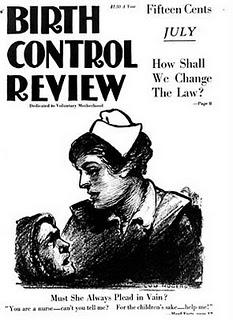
A 1919 issue of the
 Birth Control Review  

Margaret Sanger established the first birth control clinic in the United States of America at Brownsville, New York in 1916. In 1921 she founded the American Birth Control League to advocate for the adoption of artificial birth control at the level both of public policy and of individual practice. She followed this in 1923 with the establishment of the Birth Control Clinical Research Bureau which was the first legal birth control clinic and a centre of research into contraceptive methods. In 1928 due to an internal conflict she resigned from the ABCL and took full control of the BCCRB.  In 1929 she founded the National Committee for Federal Legislation on Birth Control. The ABCL and the BCCRB were reunited in 1939 as the Birth Control Federation of America, which became the Planned Parenthood Federation of America in 1942. Sanger did not lead the merged organisation but she was responsible for the founding of the International Committee of Planned Parenthood in 1948 which became the International Planned Parenthood Federation in 1952. Sanger was its first President and held this position until 1959.
The above narrative alone demonstrates the extent of Sanger’s commitment to the ideology of birth control. In the first part of this series we saw that Sanger was an advocate of sexual ‘liberation’ and saw contraception as a means of allowing women to pursue a promiscuous ‘liberated’ lifestyle while attempting to avoid the natural consequence of their behaviour. We have also seen, in Part II, that she came to adopt the Malthusian position that birth control was the only solution to the problem of poverty.  However Sanger had a much wider agenda than merely reducing the birth rate. She believed that a ‘qualitative factor as opposed to a quantitative one is of primary importance in dealing with the great masses of humanity.’[1]  In other words she saw the primary end of birth control as improving the ‘quality’ of the population rather than population reduction. In 1921 she stated that ‘The campaign for Birth Control is not merely of eugenic value, but is practically identical in ideal with the final aims of Eugenics.’ She continued ‘The most urgent problem today is how to limit and discourage the over-fertility of the mentally and physically defective... Possibly drastic and Spartan methods may be forced upon society if it continues complacently to encourage the chance and chaotic breeding that has resulted from our stupidly cruel sentimentalism.’[2] She considered certain human beings to be ‘human weeds’ who ‘clog up the path, drain up the energies and resources of this little earth’.[3] On another occasion she regretted that while ‘nature eliminates the weeds... we turn them into parasites and allow them to reproduce.’[4] Such sentiments are not original. Sanger is here expressing opinions which were identical in substance to those of other prominent supporters of eugenics such as Francis Galton, H.G Wells and Marie Stopes.
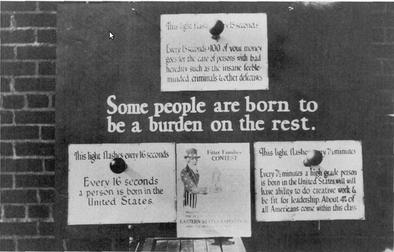
An American billboard promoting Eugenics
Margaret Sanger was a long term member and supporter of the American Eugenics Society and encouraged cooperation between organisations advocating eugenics and those advocating birth control. A majority of the AES’s ‘Committee on Eugenics and Dysgenics of Birth Regulation’ were in fact formally associated with Sanger organisations. A main aim of the eugenics movement at this time was to introduce forced sterilisation for those deemed ‘defective.’ Sanger openly advocated that ‘defectives’ should be segregated or sterilised. She expressed her frustration that eugenic programmes were not being implemented more swiftly: ‘We know, without doubt, that certain groups should not reproduce themselves. Why not say so... We cannot improve the race until we first cut down production of its least desirable members.’[5] In her ‘Plan for Peace’ published in 1938 Sanger called for segregation, sterilisation, and what amounted to slavery and forced labour for the ‘unfit’:
d. to apply a stern and rigid policy of sterilization and segregation to that grade of population whose progeny is tainted, or whose inheritance is such that objectionable traits may be transmitted to offspring.
e. to insure the country against future burdens of maintenance for numerous offspring as may be born of feebleminded parents, by pensioning all persons with transmissible disease who voluntarily consent to sterilization.
f. to give certain dysgenic groups in our population their choice of segregation or sterilization.
g. to apportion farm lands and homesteads for these segregated persons where they would be taught to work under competent instructors for the period of their entire lives.


More than 30 American states practised compulsory sterilisation during the period from 1907 to 1964 leaving behind more than 63,000 victims whose suffering has never been adequately recognised. Around 60% of these sterilisation were performed on women, yet many of Sanger’s feminist biographers have been willing to ignore her complicity in this system, lest it force themselves or their readers to challenge the notion that Sanger was a great ‘liberator’ of women.
An objective assessment of her published writings leaves no doubt that one of Sanger’s primary aims in advocating birth control was bring about the creation of a future purified race that conformed more closely to those ideas of perfection that prevailed among her own circle. The freedom that Sanger advocated was merely the freedom to indulge in promiscuous sexual acts while frustrating their natural outcome. The freedom to pursue a normal family life was not something that Sanger recognised. Indeed any woman who preferred raising a large family in the normal context of marriage was deemed for that very reason to be ‘irrational’ and unworthy of the vision of sexually liberated womanhood that Sanger had set before them. Her successors in the abortion industry today are still implementing a eugenic programme though they hide behind the rhetoric of ‘choice’.  Parents of children with disabilities are often put under enormous pressure to have their children killed in the womb with the result that, for example, 90% of children with Down’s Syndrome are eliminated before birth. In a society still dominated by the eugenic principles which have been propagated among us for more than a century what kind of ‘choice’ will most parents feel ‘free’ make?


[1] Margaret Sanger, The Pivot of Civilization, 1922
[2] Margaret Sanger ‘The Eugenic Value of Birth Control Propaganda’, The Birth Control Review, October 1921
[3] Margaret Sanger, ‘The Need for Birth Control in America’ Birth Control: Facts and Responsibilities ed. Adolf Meyer, 1925
[4] Quoted in Angela Franks, Margaret Sanger’s Eugenic Legacy, p48
[5] Taken from a letter written to leading eugenicist Frederick Osborn in 1939 and quoted in Franks, Sanger, p11-12 

Friday, 21 September 2012

Hard cases make bad law


Abortion is an issue which comes up time and time again during the US presidential elections. This year is no exception, not least because President Obama takes an extreme position on the issue of abortion, has done since his time as senator in Illinois and is expected to continue if he is elected for a second term as president. According to Pam Sutherland, chief lobbyist for the Illinois branch of Planned Parenthood (PP), Obama worked closely with PP when it came to votes on abortion legislation. According to Glenn Kessler of The Washington Post, Obama towed the radically pro-abortion PP line on the following: the Partial Birth Abortion Ban Act; the bill to protect liveborn children; the bill to protect children born as result of induced labour abortion where “born-alive infant" includes all infants "born alive at any stage of development." He also co-sponsored the 2007 Freedom of Choice Act (FOCA) in the US Senate. Since his presidency, Obama’s administration has blocked attempts to defund PP, has reversed the global gag-rule which prevents US dollars funding abortion overseas, and opposed a bill to ban gender-selective abortion, to name a few. The ethical considerations of certain legislative proposals are one thing, but the clear and persistent pro-abortion motivation of Obama is clear.   

Kathryn Sebellius, the secretary of Health and Human Services in the Obama administration has also unveiled the HHS mandate in the past year which has been virulently opposed due to the fact that it forces even religious institutions (who employ people of different faiths) to pay for abortifacients and contraception as part of their employee insurance plan 

Finally, Todd Akin, a member of the Republican party, recently made a reference to ‘legitimate rape’ and the idea that a woman rarely falls pregnant after being raped owing to the trauma caused by rape. 

Republican presidential candidate Mitt Romney is well known for his changing position on the issue of abortion, though he issued a pledge last year outlining his position on abortion and stating that he only supports abortion in cases of rape, incest and to save the life of the mother. As we know, this is contrary to the authentic pro-life position, which values all human life from conception until natural death, regardless of the circumstances surrounding the conception. Romney recently appointed Paul Ryan as his vice-presidential candidate, who is pro-life and has consistently supported pro-life legislation. Nonetheless, despite Romney’s choice for VP, the Romney-Ryan ticket will run on Romney’s partially pro-life stance. This is contrary to the advertisements produced by the Obama campaign, which claim that Romney supports a blanket ban on abortion.


People whose lives were brought about by rape are often some of the strongest voices in the pro-life movement, precisely because their lives, along with those of the disabled, are most often included in the ‘exceptions’. They are often excluded from the protection of the law, as are disabled babies, because many consider the idea that a woman should be ‘forced’ to continue this type of pregnancy too awful (in the UK, for example, abortion is legal up to birth for disabled babies). Rebecca Kiessling’s mother, who was violently raped and fell pregnant, tried to abort Kiessling twice and failed. Kiessling, who lives in the US, is now a strong voice for the unborn and particularly for those who are conceived through rape. As a recent article on LifeSiteNews.com points out, there is no difference between a baby conceived because of rape and a baby conceived through normal intercourse. Why then, should these children be treated differently? More importantly, why should any unborn child be treated differently, regardless of disability or circumstance? After all, it is not our circumstances which define our humanity and therefore our right to life, but the fact that we are human.

Kiessling appeared, alongside Gloria Allred, a woman who had been raped and aborted her unborn child via a ‘backstreet abortion’, on ‘Piers Morgan tonight’ to discuss Akin’s comment and abortion in cases of rape. Kiessling makes a valid point during the debate which draws no response: “I’m a woman, you say you care about women...what use is my right to anything if I don’t have the right to life?”.

Shauna R. Prewitt wrote in 2009 that many laws are passed to facilitate abortion in cases of rape and incest, but what real support is given to the women who choose to keep their rape-conceived children? 

“...few states have passed special laws to aid the large number of raped women who choose to raise their rape-conceived children. Without such laws, a man who fathers a child through rape has the same custody and visitation privileges regarding that child as does the father of a child not conceived through rape. Moreover, as a result of this legal absence, raped women and their children are left to face substantial and potentially terrible consequences” (p.829).

Whilst modern radical feminists continue to scream and shout for ‘reproductive rights’ especially in cases of rape, how many are supporting their fellow women who make the courageous decision to choose life? 

Thursday, 13 September 2012

What’s wrong with gender selection?


There seems to have been a flurry of media coverage on gender selection recently. An article in the Evening Standard quoted the British (Cambridge) trained Dr Steinberg claiming that he had helped around 400 couples choose the gender of their child. The Daily Mail reported that Dr Steinberg currently sees around 40 British couples a year charging around £30,000 each, and the Daily Telegraph quoted him claiming he has even assisted some UK politicians:

“I have had leading British politicians from the UK coming here, to this office, for services that are outlawed in the UK”

This is rather concerning because sex selection is illegal in the UK under the 1990 and 2008
Human Fertilisation and Embryology Act, which states that reproductive technologies cannot authorise any practice designed to secure that any resulting child will be of one sex rather than the other”. In the Evening Standard a description of the process is provided:

“We harvest on average around of 10 eggs, of which eight or nine will be successfully fertilised,’ says Dr Steinberg. ‘We biopsy the fertilised eggs, and will lose at least half from genetic abnormalities. Then half of those remaining are going to be the wrong gender, so we will be left with just one two of the gender we want, to implant’”

On the clinics website they say something similar:

“After 3 days, several 8-cell embryos will have developed. Our doctor-scientist specialists examine the genetic makeup of the embryos, screening for both genetic diseases and desired gender. Healthy embryos of the gender you desire are implanted in the mother. Any additional healthy embryos may be cryo-frozen for future use.”

Arguing, as Dr Steinberg does, that sex selection could lead to a decline in abortion is disingenuous. Reports from 2010 highlighted the proportion of mothers aborting their children conceived through IVF. It’s argued that babies conceived through IVF are really “wanted” as the parent or parents have potentially spent a lot of money, and perhaps been through several cycles of IVF and the associated procedures. Prof Bill Ledger, a member of the Human Fertilisation and Embryology Authority, which regulates fertility treatment, said: “I had no idea there were so many post-IVF abortions and each one is a tragedy.”

This is concerning because human person exists from conception. There is no such thing as a living human person with subhuman moral status and thus the destruction of embryos is intrinsically wrong

Secondly, the issue with sex selection is that effectively life is treated as a commodity with a pick and chose attitude to children. The child is not seen as a gift, which should be treasured no matter the gender, but as a product which should meet certain demands. How can we condemn gendercide in India and China yet allow 40 couples a year to go to America to choose the gender of their child whilst sacrificing countless embryos?

As Amanda Mitchison argued in the Guardian in 2010 “It may be only a matter of time before women are demanding PGD sex selection on the NHS. If the state will fund IVF for a baby, why not for a baby girl? Or a baby boy?” With politicians going to these clinics don’t be surprised if a group of MPs get together, with the backing of embryologist researchers and fertility doctors, to legalise this. Each human life is unique, and shouldn’t be designed in a lab. The Coalition Government needs to take a hard line against this, before it is too late


Friday, 31 August 2012

What does a paralympic swimmer and a militant pro-abortonist have in common?


Sadly (for the paralympic swimmer), they share the same name. Luckily, they do not share the same outlook on life for those living with a disability. 

As the Paralympics begin and the British media tries to ‘rally the troops’ for what feels like an afterthought, it is timely and appropriate that we consider the incredible hypocrisy which exists in our society and which is reflected and magnified in the media regarding abortion and those who live with disabilities. 

On the 26th of August, an article praising the Paralympic swimmer Ellie Simmonds was published in the Sunday Telegraph. Simmonds was rightly commended for her fantastic achievement at Beijing 2008 (Simmonds became, at the age of 13, the youngest ever athlete to win a gold medal at a Paralympic Games). She also received an MBE in 2009 and was, again, the youngest person to be honoured with this award.  Simmonds does not focus on her disability (she was born with achondroplasia - a form of short-limbed dwarfism) - “I’m just small”. 

It is difficult to believe that the praise of the Paralympic athletes from some quarters is, however, sincere.  How can we possibly take seriously, for example, the adverts made by the televisual hosts of the games, Channel 4? It feels insincere when we proclaim that Paralympic athletes are ‘superhuman’ and in the same breath declare that abortion for disability is a ‘necessary evil’. Had Ellie Simmonds’ parents brought an end to her life while she was still a vulnerable and tiny human being in the womb, would anyone have protested against the execution of her mother’s ‘right to choose’? Perhaps our pro-abortion critics would answer that the essential difference is that they themselves did not protest -  that Simmonds’ parents ‘made their choice’.  One might well ask: who gave us the power to decide between life and death for any human being, to deprive them of their chance to live their life, and in Simmonds’ case, even to reach the heights of a gold medal at the Paralympic games? Even if Ellie Simmonds had never set foot in a swimming pool, even if she had never left hospital, her life is, and always has been from the moment of her conception, her own and worthy of being lived. 

In a 2001 article published by Spiked Online, Ann Furedi, current CEO of Bpas, and Dr. Ellie Lee, lecturer at the University of Kent, wrote that when a woman aborts her disabled baby, “[s]he is making a statement about herself; what she feels she can cope with and what she wants” and not a statement about the worth of people with disabilities in general.  Further on in the same article, the authors write that when a mother decides to abort her disabled child “It simply implies that she does not wish to be a mother to one”  (note the term “one”).  Furedi and Lee are clearly at ease using such dehumanizing language in relation to unborn children with disabilities (a few years back Lee went further and openly endorsed infanticide on the BBC’s Moral Maze. In the minds of Furedi and Lee, “Issues relating to disability rights are completely different to those relating to abortion”. 

In a 2003 article on abortion and disability by Dr. Lee, published by Pro-choice Forum, she writes that abortion legislation in the UK is too prohibitive. She wants to see it liberalized, including when it comes to aborting babies with a disability:

“the logical consequence of doing so is to draw the conclusion that, to put it bluntly, choice is choice. I know from my experience of making this point that some people - those who are pro-life and some of those with disabilities - get very upset about it. But it is hard to see how this issue can be avoided if we are to have an approach to abortion that is fair, coherent and moral.”

These are the sorts of pernicious ideas that people with disabilities and their supporters have to stave off. For Lee, a more liberalised abortion law is going to make the world more moral and fair.  It would be difficult to think of a better example of inverting the moral order, calling good bad and bad good. For the likes of Furedi and Lee, life will be better for the mother, and for society, when the ‘unwanted’ child with a disability is killed. Yet, comically, Furedi and Lee try to deny that they favour eugenics.  Less comic are the generous public funds that go toward funding the likes of these two, while the State sentimentally celebrates ‘the disabled’.

Of course if ‘choice’ justifies of itself, why do so many modern feminists protest against the abortions which target girls? Putting aside the contradiction in their attitude (how can aborting a girl because she is a girl be wrong when abortion is, they say, a woman’s right and a legitimate practice?), they are recognising that sex-selection abortion reflects the idea, prevalent in communities where sex-selection abortion is popular, that girls are not as ‘good’ as boys. They recognise that as long as girls are targeted in the womb, they will never attain equal status in society when they are born. In the same way, we cannot abort our disabled unborn children and then expect respect, love and support for those children who do ‘slip through the net’. 

A few months ago, a very telling article was published in the Guardian which chastised the government for cracking down on abortion clinics which carry out abortions on unborn children based on their sex, while a report had simultaneously been published which highlighted the lack of support for disabled children available today (long waits for wheelchairs, a lack of communication with the family about care for their disabled child etc). 

The journalist, a supporter of abortion, failed to see the contradiction between her two positions. Of course disabled children are at the bottom of the pile in the UK, of course they are neglected, of course they go without!  Disabled children are the lowest of the low when it comes to abortion. We know that it is almost taken for granted that a woman will abort her unborn baby if he or she has Down’s Syndrome, so why should we expect these children to be provided for when they are born?  Society needs to sit up and take notice of the horrible injustice which is being perpetrated against all unborn children who are aborted and most obviously  against those who are disabled. The Paralympics mean nothing, and are grossly hypocritical, if we refuse to protect (or, indeed, demand the destruction of) disabled members of our society in their hour of need: in the womb.
Related Posts Plugin for WordPress, Blogger...